Sunday, November 02, 2014

Dog That Didn't Bark Special - Volume Nine, No. Two - Why no Centennial Celebrations?


If you google these words, centennials "National Park Service" 3,120,000 hits come up. It seems the NPS is very excited, and spending a lot of tax payer dollars, to publicize its coming Centennial, promising even more, “Conservation and preservation.”

Merging these terms is a real mistake. The rupture between Gifford Pinchot, John Muir was percisely, exactly, over the issue of using the Hetch Hetchy, the Little Yosemite, as a reservoir. Muir, a Preservationist, lost. Pinchot, a Conservationist, won, as did the corporations who made fortunes on the flow of water into San Francisco. 

The issue of Hetch Hetchy helped determine the 1912 election, removing the opponent to this use of Hetch Hetchy, William Howard Taft, from the office of president.  Wilson, once elected, happily signed the bill allowing this to happen.   

Read the Time Line.

Could these two events have been overlooked because they occurred so early, seven and four years before the founding of the National Park Service?

Absurd. But as you read their websites they ignore the clear evidence long available online, together with the absolute absence of any mention of who the inventor of the use of film to increase public awareness of environmental issues and the  invention of a new technology. Those on line have been picked through ACPillsburyFoundation.org. Also, as mentioned previously, they received news releases along with everyone else.

Taking one National Park, Yosemite, as an example the subject of photographers is covered back to the first one, who photographed Yosemite for the first time in 1859. But wait, it is posited on these same 'official' sites there was a contender for this First. But nowhere is the name of such an individual mentioned.  Curious.  Perhaps a time traveler took along his cell phone?  The Miwok had cameras?  

The one who provably took the first photos died in 1902, was Charles Leander Weed. Weed was either hired by James Mason Hutchings, then the publisher of California Magazine, or his employer Robert Vance of San Francisco. According to some sources Charles L. Weed was to take a "Yosemite Panorama”. Today we cannot imagine an image with the dimensions of 10" x 14" being called a panorama. Then, it was a real improvement, however. 

This is what the writer is calling a Panorama.

Photo of Yosemite 10 x 14


This is a Panorama.

The Hetch Hetchy after it was dammed, you can see the reflections.
 This is not an issue of art, it is an issue of advances in technology.  So, let's be clear about what exactly is under discussion.   

These 14 x 10 enlarged scope photographs were to be added to the firm's stock and to provide a basis for engravings by Thomas Armstrong in the five articles which appeared in California Magazine.

It was hard to get to Yosemite in those days and a group of people, sponsored by Hutchings, with porters, went along. Included in the party was the Guide, Mrs Ewer, Miss Neil Hutchings, Ewer, and Weed. Cameras weighed 40 pounds and getting there took several days and a guide. This was a considerable expense, beyond the resources of most people. 

Weed arrived in Yosemite Valley around 9:30pm on June 17, 1859. During their 1851 – 1860. Photos were taken as everyone enjoyed the scenery, this going on for several days.

So, the confusion, or obfuscation, is not about these two distinct events in 1909 and 1912 alone. These were events which resulted in Pillsbury lecturing and showing his movies at every Town Hall in America and at all the major universities.  Pillsbury short subjects were also sold to Hollywood to be shown before the 'feature' film. 

Nature Movies take us to the wilderness without risk or cost and certainly impacted how people living in cities viewed the world of nature.  Lapse-Time films did the same.  These were not small, irrelevant events.  These technologies are still opening people's eyes today.  

There is more. That Dog is still not barking, but he will. Sign up to receive tomorrow's DTDB Special.  

Saturday, November 01, 2014

Dog That Didn't Bark Special - Volume Nine, No. One - Why no Centennial Celebrations?


The Centennial for the first Nature Movie took place in June 1909. We sent out news releases and held a small event. No one came.

That first showing was at the Studio of the Three Arrows in Yosemite. The film was made by Arthur C. Pillsbury.

Pillsbury had previously designed and built the first circuit panorama camera as his senior project at Stanford where he was majoring in Mechanical Engineering. His first invention was a specimen slicer for a microscope, designed and built in 1895.

The local paper, the Palo Alto Times, reported the event.

28 November - Palo Alto Times - ``An Ingenious Piece of Work"
``...and it was for Mr. A.C. Pillsbury, our ingenious young bicycle man, to first introduce one [microtome] of domestic manufacture." Microtomes used to cut insects so they can be seen in microscope." (some on machine)
``The machine is indeed ingenious and when it is considered that the whole work of designing and making the parts was done by Mr. Pillsbury at his own shop, it marks him as one with unusual mechanical ability."

His senior adviser, Professor Rice, had looked at the design for the circuit panorama camera and told him not to bother, it could not work.

Ignoring this sage advice Pillsbury built the camera. It worked. Pillsbury left the University and headed for the Yukon where he used the camera to record the opening of the mining towns down the Yukon River from its headwaters to the ocean.
Nome Alaska, two months old
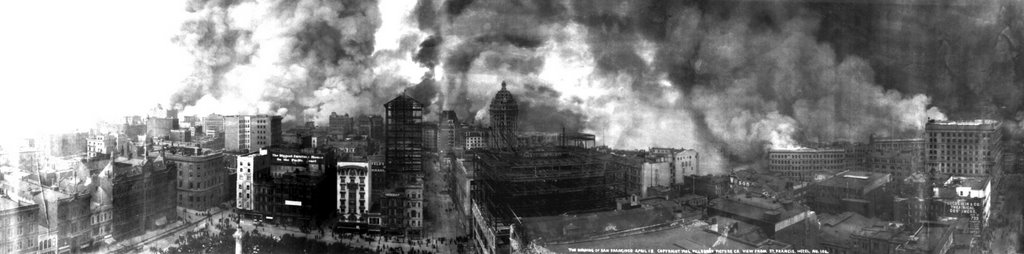
Pillsbury used it again to record the first hours of the San Francisco Earthquake and Fire on April 18, 1906. 

No. 101

Making hundreds of photographs, panorama and conventional, Pillsbury made enough money to achieve one of his long term goals by purchasing the Studio of the Three Arrows in Yosemite. He used post cards as a form of advertising. A short while later this same year, 1909, he achieved a certain notoriety in San Francisco by being cast away in his balloon while doing aerial photos of the rebuilding of San Francisco.

Three years later, as what he describes as a 'hobby,' he designed a lapse-time camera which could speed up events for the human eye and show a flower blooming. The film was first shown on October 16, 1912 to a conference which included Park Superintendents from around the country.

Again, no Centennial, though we sent our news releases. Curiouser and curiouser.  The National Park Service expressed no interest and did not return my phone calls.  But both these events took place in Yosemite, a certified National Park.  

When the dog does not bark there is always an explanation.   

Thursday, July 29, 2010

Volume Five - Special Issue - 2010

Melinda Pillsbury-Foster


This is a special issue of IMAGE to bring you up to date with developments which have been taking place for many years behind the scenes, so to speak.  In the last 24 hours I have been contacted several times regarding a statement made on the Ansel Adams Blog by Adams grandson, Matthew Adams.
In his statement, for which he sought no authentication from myself, I was quoted as having stated the glass plate images now known as the Norsigan Negatives, and which have been valued at $200,000,000, were not my Grandfather's work. I never made any such statement and, in fact, think they may well be.  My requests and suggestions for objective authentication were ignored by all parties.
I prepared a statement regarding these negatives and the other materials which I examined myself in 2002 at the Norsigan home in Fresno.  These would, perhaps, be minor issues except for ancillary events which document a long time pattern of behavior on the part of the Adams Family. 
Adams goes on to state, "Arthur Pillsbury was active in Yosemite, and moved from Yosemite to Los Angeles."  One has to wonder what the man is smoking. The many inaccuracies which have flowed from the Adams Family as a source, working their way into published works, over the decades in regards to my Grandfather can no longer be tolerated.  That, along with the lack of any standards for reputable research, ignoring the obligation to contact me before publishing, and lack of attribution for his statements, must end. I immediately demanded a retraction and have not heard from him or anyone else associated with the Adams Family. 

My statement is below. An edition of the usual newsletter will be out in a month and, with an article on AC's  lectures, contain an articles on these events. If you would like to receive further updates please send a notice to winkey@acpillsburyfoundation.org.

John Clark, a member of our Board of Directors and a good family friend, has agreed to assist us in this matter as a media liaison.  John is a producer and director


FOR IMMEDIATE RELEASE
Further Information
Contact: John Clark
P.O. Box 3869
Hollywood, CA 90078


STATEMENT IN RESPONSE TO MATTHEW ADAMS ON THE NORISIGAN NEGATIVES

The following statements were attributed to me on the Ansel Adams blog site and are factually untrue and do not correctly reflect any comment ever made by myself.

From Matthew Adams on the Ansel Adams Blog, July 24, 2010,“That is a subjective opinion, but does narrow the field of alternatives. Boysen, Fiske, & Watkins were deceased by the estimated time of the negatives. Arthur Pillsbury was active in Yosemite, and moved from Yosemite to Los Angeles, however the negatives have been disclaimed by his grand-daughter, Melinda Pillsbury-Foster.”

I never disclaimed a possibility the negatives or the nitrate film, which Mr. Norisigan told me were in the envelopes at the time he bought them, were my Grandfather's work. Mr. Norisigan asked me to view the materials and I did so, visiting him and his wife at their home in Fresno in late autumn, 2002. While there, I examined both an assortment of glass negatives and envelopes. The visit lasted several hours and included a lengthy discussion on Mr. Norisigan's contacts with the Adams family. I made notes at the time and have now reviewed them. The information relayed to me concerned the materials being examined, how these were acquired, and his attempts to deal with issues raised by the Adams Family visit to view the materials in his possession.

Regarding Adams statement on my Grandfather's residence. My Grandfather lived in Berkeley-Oakland from 1906 until his death in 1946, a well known fact since he was a nationally known lecturer and had lead the application of photography to science. The list of his inventions includes the lapse-time camera for plants, (1912) the microscopic motion picture camera, (1927), the x-ray motion picture camera, (1929), and an underwater motion picture camera, (1930), which he used to produce films for his lecture series heard and seen by scientists and the general public around the world.

I offered Mr. Norisigan this opinion. The glass negatives appeared to be high quality, professionally produced images of the classical tourist sites of Yosemite. This was obvious at a glance. I had seen similar images, what my Grandfather called, 'Production Photos,' by the other professional photographers who worked in the Valley as well as my Grandfather's. Similar images by other photographers I had seen were produced on paper, however. I suggested, because of the similarity in all these common shots, Norisigan have these compared to the work of all photographers known to have worked in Yosemite using appropriate forensic equipment. Even with very similar professional images differences in the trees, clouds, and flow of water can make identifying the photographer certain by comparison with known work.

I further advised him to seek information on the numbering systems used by Yosemite photographers from Leroy Radonovich, the recognized expert on the subject.

During the course of my visit I told Mr. Norisigan I was aware of only two photographers who had systems which included numbers during the years which Norisigan named as the dates assigned to the glass negatives and envelopes. My Grandfather was one of these. The second, whose name evades me at this moment, had less than 1,000 photos in his collection.

The numbers on the envelopes I viewed were four digits, the first number of each being '8.' The numbers fit into a lost section of my Grandfather's collection, which I have worked to reassemble for over twenty years. By 1927 Grandfather's collection numbered in the many thousands. Grandfather routinely named his photo images as well as using a numbering system. The name and number did not vary, no matter how the image was produced, though in some cases, for instance on the d'orotones, the name did not appear on the image itself but on the label pasted on the back.

Before I left Mr. Norisigan provided me with Xeroxed copies of the envelopes, which are still in my possession.

I am not aware of any other Yosemite photographers who were producing d'orotones during this period. D'orotones were, of necessity, produced on glass at that point in time and Grandfather was selling many of these. Grandfather had produced a 6 foot square d'orotone for the head of a Hollywood studio around 1924. That piece sold for approximately $25,000 that same year.

I expressed the opinion at the time, and still believe, the 'Norisigan Negatives' might be my Grandfather's work. Through examination carried out by third parties I hoped to remove all doubt as to their origin.

I then suggested to Mr. Norisigan the glass plates in his possession be compared with the partially finished d'orotones I was shown by the Yosemite Chief Archivist on the occasion of my visit there in the early 90s.

This box of d'orotones, presumably still in the possession of the Yosemite Archives, I believe to be the work of Arthur C. Pillsbury. Not only did they strikingly resemble those produced at the Studio of the Three Arrows when I viewed them but the dates provided to me by the Chief Archivist as to when they were discovered would have coincided with the end of Grandfather's presence in the Valley, 1895 – 1928.

In the early 90s the box showed no sign of having been inventoried or examined. During the same visit I viewed an album of photos memorializing the building of the Glacier Point Hotel in 1918. The album followed the construction from the laying of foundations and was exhaustive, beautifully and professionally done. I commented on the likelihood these were taken by Grandfather to the Chief Archivist, who was standing with me as I leafed through the album. The Archivist pointed out they were not signed. I flipped the album over and the imprint of the Pillsbury Picture Company was on the back of the whole album. The Archivist made no further comment, refusing to discuss this or other issues.

It is not possible for competent professionals to overlook such clear evidence and fail to credit the individual who produced the work absent other factors. I found this, and other similar incidents disturbing.

At the time, and today, I believe the box of d'orotones to be my Grandfather's, stolen from his studio just before it was burned in November, 1927. These should be treated as possible evidence of a crime and compared to those presented as the Norisigan Negatives.

This research should be carried out by forensic experts unconnected to the Park Service, the Adams Family, or the Norisigan Team. All the items in question should also be fingerprinted and careful records of the full proceeding made public immediately.

Signed, July 29, 2010

Melinda Pillsbury-Foster

Tuesday, January 27, 2009

Volume 4 - No. One - Winter 2009


Volume Four, Number One - Winter 2009

Help us fund sustainable commerce and at the same time help vets overcome their Post Traumatic Stress Syndrome! This is a rare opportunity to own an original AC Pillsbury d'orotone with letter of provenance. This particular d'orotone of Lake Tenaya in Yosemite, was matted by AC himself and given to his son, Dr. Arthur F. Pillsbury, for Christmas in 1941. The reserve price is $2,000. Send your offer to: winkey@acpillsburyfoundation.org now. Watch for a new line of d'orotones that will also help us fund what America needs!


The image is bright and sharp, the product of a new process AC never sold commercially.


Under-Sea Photography

Just one adventure of a life time.


He sailed to Pago-Pago in 1930 for the purpose of filming the first underwater motion picture. With him he took two cameras sealed in brass waterproof boxes he had designed at home in Oakland, California. A mechanical engineer, Arthur C. Pillsbury built his equipment in his own shop. In his book, Picturing Miracles of Plant and Animal Life, Pillsbury' provided instructions on how to do the same, building your own kit or having it made for you from his designs. He included estimates for cost along with materials. He advised the reader to learn how to swim, pointing out that this was a good idea if your intention was to photograph the residents and landscapes under the ocean.


With lapse-time photography for plants, the microscopic camera, and the X-Ray motion picture camera under his belt he was looking for more parts of the world to reveal to human eyes and minds. As audiences listened to his lectures on worlds previously unknown few, perhaps, reflected on the fact that the images they were seeing were changing the world in which they lived. But that was happening.


In Pago-Pago Arthur C. Pillsbury found water clear enough to allow him to photograph the world of living creatures and landscapes that few people had ever seen. The first underwater motion picture was produced.


The trip had taken enormous preparations in work and study. Pillsbury wrote in his book, “icturing Miracles of Plant and Animal Life,“The cameras must be protected from salt water, inside a waterproof metal box and still allow me to do all the things necessary, so I designed brass boxes for two motion, and one still, cameras and then a graphite-lined double-trapped stuffing box that was water-tight and still allowed me to crank the cameras, focus them, set the shutter, make the exposure and handle them almost as well from the outside of the brass box as I could no land.”


The book was, among other things, an instruction manual in how to build your own camera. It provided instructions on how each camera, lapse-time, microscopic motion picture, X-Ray and Underwater, was built, just in case you wanted to do it yourself.


The underwater cameras and breathing equipment were heavy on land, light in the water, one camera weighing 170 Lbs on land and only about 30 pounds when submerged.


The cameras were tested in advance, ensuring that the pictures made through the optical glass windows would work. Then came the task of readying his own gear.


Buying a second hand helmet he found it was so heavy he could not lift it an put it on his shoulders unaided. No matter. He knew that once underwater it would be more like wearing a hat, he said. The air pump, the air lines, film, all parts and replacements must be accounted for, packed, and carried with him. When the hardware store in three weeks away you can't mosey down there for the part you need. Pago-Pago was very primitive.


Arriving in Pago-Pago, Pillsbury chose the location for his film, considering the issue of coral that was attractive while avoiding the hazards the coral presented to bodily parts. Humm, he wrote walking across the coral strewn area, I will wear tennis shoes while exploring my filming sites. Having never dived before he knew he must learn that new skill rapidly if he was to return home with the film he wanted for his lecture tour.


No floating experience was involved. The 'boys' dropped him off the side of the boat and he landed in the sandy bottom below, spending some time clearing out his glasses so he could see. Then, to work. The sights were glorious.


I soon began to enjoy the work very much and would stay down two of three hours till I had used all my film or taken all the good locations within reach of my hose and life line. Reaching the bottom I would pick up a tripod, metal to weight it, and a piece of ten-foot gas pipe for a cane and measuring rod, walk around till I found just the view I wanted-good coral, lots of fish and the right light, set up the tripod, measure the distance carefully, go back to get the camera, having to remember the direction as I could not see it even in that clear water if it was over twenty-five feet away, but I knew it was under the launch,and I could see her in the “ceiling” above me.”


Fish were everywhere, swimming all around me, peeking into the window of my helmet, wondering perhaps what sort of new kind of fish I was. They were very tame, I could almost touch then, all colors-blue, yellow, black, red, even the delicate orchid and dater shades and so many combinations it was impossible to describe them.”


Pillsbury learned how to dive, use his camera, took notes for his lectures, completing his work in just few weeks. Learning to focus his camera underwater was handled efficiently, with on the spot testing showing him how to ensure his films would be sharp.


Walking in the forest of coral higher than his head he avoided the dark caves both because they could hold danger and because he could not photograph their contents in any case.


Encountering giant clams he said, “The giant clams thirty inches in diameter, large enough to weigh almost a ton, could crush the large bones of your leg if they close on it. I saw only one of these huge fellows and it would have taken a derrick to pull him loose and raise him into the boat”


Also present was the threat of sharks, which the native boys who stayed in the boat, knew from experience to watch for. Jelly fishes were also dreaded by the natives, some of these having tendrils ten feet long and poisonous.


Still, with ordinary care there is no more danger than crossing a busy city street dodging one of “Henry's sharks,” and others of the species.” In this way Pillsbury tipped his hat to Ford.


In the end Pillsbury spent only ten days getting his films. It was enough. America was amazed that next year with scenes that lite their imaginations, leaving them wanting to know more about the world beneath the sea.


Few people visited Pago-Pago then. Aside from Navy personnel few people from the outside saw the glories of the islands. Now, thousands saw its underwater beauties and its people as Pillsbury toured America bringing the images and stories of their world to ordinary people.


Almost no tourists come on account of the lack of hotels. Steamers southbound from San Francisco arrie with mail every three weeks and that is the grand market day for the natives. They gather in the Malai, a level grass-covered place in the village, and have their wares on sale-all sorts of things to tempt the tourist, tapa, kava bowls, Hula skirts, shells, coral, native fruit, model boats, war clubs, home-made jewelry, etc. It makes a colorful display, even the humble hen's eggs find a lace in this market place.”


Pillsbury and his wife eagerly bought Alofas, gifts, for their families at home in California. The holidays were coming, always a warm family event for all of them.


As they were leaving Pillsbury noticed the boy who had watched for sharks while he was filming many feet below the launch. Realizing he had forgotten to say goodby he hastened shore to say his farewell, giving him a small gift of thanks. “At the same moment he reached down, picked up a small kava bowl, passed it to me and said, “May God be with you on your journey home and ever afterwards. I trust you wish the same for me.” It took my breath away. I think it was the first time I had heard him speak English as he talked to Happy, my head boy who handled the life lines, in his native Samoan language.”


Pillsbury was both surprised and delighted. He had long realized that people were all more alike than different. With Happy Pillsbury had had long talks on conditions in the Islands, comparing them to California. Happy had wanted more education that the local schools could provide. A correspondence was taken up only to end with the beginning of World War II.


The images that Arthur C. Pillsbury took in Pago-Pago were to amaze minds. Those taken under the sea enlarged our knowledge, opening doors previously shut. The photos you see here show the other story of Pago-Pago, the story of its beauty and the people AC came to know well during those weeks. When the ship steamed into San Francisco the lecture on Life in and Under the South Seas was ready to present to America.


Help us bring the story of Arthur C. Pillsbury to the world by purchasing a reproduction of one of these these photos, produced for the family that Christmas as d'orotones. Give one to someone you love, a gift that gives in 360 degrees of connection. Visit the Store to see the image now available.


Friday, August 08, 2008

Volume 3, No. 1 - Summer 2008

Arthur C. Pillsbury - You See The World Through His Eyes

No matter where you live today you see the world through the eyes of a man of whom you are probably unaware. Over a period of half a lifetime Arthur C. Pillsbury designed and built the cameras that changed our beliefs about nature and science.

Pillsbury's career would lay the groundwork for the use of photography as we know it today. Seeing is understanding. Seeing connects us with immediacy and power, providing both the medium for art and for all human innovation.

The cameras invented by Arthur C. Pillsbury remain with us. Each was conceived and built to provide the means for Pillsbury to solve a problem he confronted and was determined to solve. While still in college he considered how to widen the frame of a lens to produce a more expansive image. He solved the problem by designing and building the first circuit panorama camera. With that camera he chronicled the opening of the mining fields in the Yukon, explored the entire West Coast, and recorded the San Francisco Earthquake from the first day on. The images captured were not always beautiful, but they were always true to life. Images have continued to provide us with needed insights through wars, tragedies, and celebrations. Photojournalism, just one application of the technology of photography, has changed lives and our national direction.

In 1910, realizing that the number of species of wild flowers in the meadow near his studio in Yosemite were decreasing; Pillsbury built a camera that would capture the growth progression of flowering plants so that the plants themselves could tell their own story. Today all of us are familiar with the the images of a flower lifting its face to the sun in a dance-like motion. Flowers in motion, captured by time lapse photography grant us entirely different perspective on their life cycle and the need to preserve them.

Ever the pioneer and pushing the technological limits of photography of his day, on May 17, 1919, Pillsbury took the first aerial photos of Yosemite. This new view of the Yosemite valley provided perspective on the park unknown until his film was made. He used short films on nature to teach environmentalist themes. His films began to be shown in movie theaters. He was the first film documentarian that took environmentalism from the classroom to people.

In 1927, in a lab loaned to him by UC Berkeley, Pillsbury build a microscopic motion picture camera. His images stunned the scientists of the day. They had spent their careers studying dead samples under their microscopes. With Pillsbury's new camera living samples could projected on a screen in a lecture hall. The ability to capture events with the microscopic motion picture camera has created explosive waves of discovery in every field of science.

Pillsbury's motion picture technology caught the attention of leaders from around the world who wanted to bring his technology and his way to impart information to their nations. He found himself awash with invitations to present his perspective on nature as a living, growing changing system of plants and animals interacting with the environment. By 1930 Pillsbury invented the X-ray motion picture and underwater motion picture cameras. The focus of his life's work was connecting you to the worlds we could not see without the extension of human vision made possible through his photographic innovations.

Pillsbury's cameras were not patented. He believed that his inventions could be improved upon by those who were inclined to improve them. His mission was not patenting inventions but instead creating new photographic technology to carry on his work. Although an idealist Pillsbury did patent his mass production machine for photo post cards in 1922. The sole patent was intended to provide resources to fund work that would follow. As for cameras he provided them as gifts for our use and development. He wanted them to be available to everyone. To that end he wrote a book, “Picturing Miracles of Plant and Animal Life,” that explained in each case how the camera used were built so others could do the same.

The world has used his work lavishly. His earliest educational films, then produced for schools at all levels, were used worldwide. He created new awareness of the natural world; His photographs of people connect you to the warmth and humanity of the man behind the camera, reflected in the faces of those who see images remain for us to see. His legacy remains with us through those images and also through our own minds and eyes as we see the world today. His images stay with you because for Arthur C. Pillsbury people remained in the frame.

In every part of our lives photography touches us, changes us, informs, and increases our awareness of our world. Arthur C. Pillsbury was one of the first photographic pioneers beckoning us on with images and insights. But he was more than that as you will discover for yourself as you understand his life's work.


From “Miracles of Plant and Animal Life” by Arthur C. Pillsbury

“Beauty, Form, and Color, the Rhythm of movement, express art everywhere. The story of a bud opening, a leaf unfolding, a seed germinating, all the various steps of its life struggle for perpetuation, is as interesting and poignant as one's own life's happenings. Step by step the lens has registered on a sensitive film of a lapse-time, motor-driven motion camera, recording in that way in a comparatively few seconds life efforts that may take days or even weeks to happen.....

...Man looks at a flower in passing: the eye would soon tire in trying to watch the growth or change of position, but the lapse-time camera, running at a speed to record in the time we have to see it, registers every change of position day and night with a tireless lens eye, and all from the same chosen position, writing on the film what happens in lines, expressing position, growth and color until finally death, or better call it, when its parts have fulfilled their life's duty, passing onto another form.”


Life Time Accomplishments


  • 1895 – Invents specimen slicer for microscope at Stanford

  • 1895 - Photographs first Rush at Stanford

First visits Yosemite via bicycle from Palo Alto

  • 1896 - Invents circuit panoramic camera, as senior project at Stanford.

  • 1897 - Leaves for Alaska to chronicle Gold Rush

Shipwrecked and rescues himself.

  • Trip from the headwaters of Yukon River to sea in a canoe.

  • 1903 - Begins work as photographer in San Francisco

  • 1906 - Photographs Earthquake, distributes world-wide.

Buys a studio in Yosemite.

Photographs the Missions of California and sites of interest through out the state.

  • 1910 - Aerial photographs of rebuilding, runaway balloon.

Balloon breaks free. He is reported dead.

Films first nature movie, shows it at The Studio of the Three Arrows in Yosemite.

  • 1911 - Begins work on lapse-time studies on flowers

  • 1912 – Builds and films the first lapse-time movie of a flower blooming.

Stops the cutting of the wildflowers in the meadows of Yosemite by persuasion.

  • 1921 - First aerial motion pictures of Yosemite.

  • 1922 – Patents the first mass production unit for photo postcards.

  • 1924 - First color motion picture, produced for his lecture series.

  • 1927 – Builds the first microscopic motion picture camera in a borrowed lab at UC Berkeley. Dedicates it to science.

  • 1929 - Builds the first X-ray motion picture camera.

Makes the first movie using the X-ray motion picture camera.

  • 1930 - First underwater motion picture

  • 1935 – Photographed the process of hydroponics carried out by Professor Gericke at Berkeley

  • 1942 - Documents process of osmosis in plants.


Find some of his images at:

http://www.cafepress.com/pillsburypicco/

acpillsburyhome.org

pillsburypicturecompany.com

Introducing the Arthur C. Pillsbury Gallery! Look for it at photobiz.com, with lots of photos and a new beginning.

Thursday, September 21, 2006

Spring 2006 Volume 2 Number 1

In this issue: Converting disaster to environmental progress

The First Nature Movies: Studio of the Three Arrows

Things that will be happening


Acquire a piece of history

You can purchase a remastered copy of the original of this picture. For information contact us at:

winkey@acpillsburyfoundation.org


The Centennial of the San Francisco Earthquake and Fire

Converting disaster to environmental progress


That anniversary of the Quake and Fire that completely changed San Francisco passed last April 18th with parties and commemorations. Ancient survivors of the event, delighted to be lifted from lives of obscurity, waxed eloquent in the spotlight. However, although the reasons that the Quake and subsequent Fire are now well known and documented very little was said about those root causes.

For Arthur C. Pillsbury the Earthquake and its aftermath was life changing.


The morning of April 18th was a memorable one. The earth quake shook me out of bed. It did some light damage to the house. I grabbed my cameras and started for San Francisco. Fortunately I had saved my press badge when I left the Examiner and knowing all the police in the city I could go everywhere. That Wednesday I covered the entire city, making 5 X 7 Graflex views and panoramas of the burning city. ”


On that first day Pillsbury shot over 70 snap shots and two panoramas, one from the top of the Merchants Exchange Building covering the wholesale section just at noon, and one from the top of the St. Francis Hotel showing almost the entire city in flames.


It was these photos that went out to newspapers all over the world because the destructive might of the Earthquake and Fire had shattered the other facilities that photographers used to develop their film. At the Pillsbury home in Oakland there was running water. Faced with the problem of continuing supplies, Pillsbury sent buyers out to towns as far as 500 miles away to meet the demand for the images. Over the next weeks prints from a single negative of one of the panoramas taken that first day would bring in from $500.00 to $700.00 a day. The photos would also appear in the new San Francisco Magazine, the lay out of images catching the despair and desolation coming on the heels of the erupting inferno.


The panorama negatives measured 44 inches in length and could be blown up to lengths greater than nine feet, showing incredible detail.


At the end of the first day, Pillsbury left his panorama camera, a large and unwieldy mechanism, in the cloak room of the St. Francis Hotel and that night and it was consumed along with the hotel. The film had gone with him, tucked in the pocket of his jacket. The shots taken with the Graflax camera included a shot of the Palace and Grand Hotels coming down, drenched in flame, caught as it seemed to dissolve before your eyes. He reported in his autobiography that the heat was so intense that while taking the picture it scorched the lens making the balsum run and so spoiling the photo. The bellows soon dropped to pieces, he said.


Included in the hundreds of images made by Pillsbury over the next few weeks were scenes filled with destruction, shock, and courage, showing the City as it continued to burn and the people as they struggled to survive and then began the long, slow, painful process of rebuilding. While taking photos and following the course of the struggle to stop the fire Pillsbury also found time to ensure that friends and acquaintances were safe. Some he sent on to his home in Oakland, where many camped out for weeks afterwards. Among these was the woman he would marry. Dragging the single trunk they had been able to save from her home in San Francisco to the ferry proved to be a one way trip for the lady. The two were married six weeks later in a small ceremony attended by both families from several parts of California.


While San Francisco survived many residents did not; some families were never reunited and never learned the fate of their loved ones. Ranging all over the City, and never far from the most intense action, Pillsbury saw acts of violence perpetrated by the military brought in to provide security. He was the incompetence of those entrusted to use dynamite to create fire breaks, instead spreading the conflagration. Those hours impacted everyone who lived through them; each carried away with them into the remainder of their lives lessons learned about human nature and the nature of the universe.


Life had taught a lesson; what we believe is solid and to be relied on can change in the blink of a moment. For Arthur C. Pillsbury it had been a real learning experience.


The First Nature Movies: Studio of the Three Arrows


Arthur C. Pillsbury had begun showing nature films, the first ever made, in 1909, advertising them on post cards then given away at such locations as El Portal. Those first films showed the wonders of Yosemite, and the wind moving through the seas of grasses that filled the meadows with Half Dome and Yosemite's other wonders in the background.


The films serves as the visual aids for the narrative Pillsbury provided. He had long been fascinated by the whole of nature. As a young boy growing up in Auburn, California, he had raised exotic chickens, cross breeding them and keeping charts on the resulting off spring while selling eggs and breeding stock to friends and neighbors. The family had come to Auburn from Brooklyn, New York, where they had lived while Arthur's mother, Harriet Foster Pillsbury, completed her education as a physician at the Women's Infirmary in what is not the Village.


Before that they had lived first in Medford, MA where Arthur was born, the last of four children, and second son. It was in the fields around Medford and during the family's trips to the Old Homestead in Sandown, New Hampshire, that Arthur first began studying botany when he was very young.


The Old Homestead had stood at the edge of Sandown since the towns inception in 1756. Benjamin Pillsbury had been born in Amesbury, MA, eldest son to Caleb Pillsbury and chosen to set off for what was then the wilderness. The Pillsbury Homestead included a lake, known now as Angle Pond but then as the Angly to the family. Here, in the old white house raised by Benjamin, Arthur ranged over the Angly and studied the plants native to the area. The old house was full of books by early naturalists that had been used by generations of the family. So the wild flowers of Yosemite became another page in his life long love of nature, so sharing that knowledge with others came naturally to him.


He understood that most people were not blessed with a family who took such knowledge for granted extended and so the lectures on the world of nature found in Yosemite combined his own interests; nature and making a living in a place that had fascinated him since his first trip there in 1895.


Each year more films were added to his library so that the same films need not be shown but could be varied.


Soon after his purchase of the Studio of the Three Arrows Pillsbury noticed something. The meadows were changing. At that point in time the meadows were being mowed to provide fodder for the horses oforthe Cavalry, who were still in Yosemite as its caretakers and stewards.


Each year Pillsbury noticed that the number of species of flowers in those meadows was diminishing. If Muir had been focusing on the issue of the preservation of these fragile life forms he would have begun a petition campaign to Congress. But Muir was then completely focused on stopping the building of a dam in the Hetch Hetchy. The wild flowers had no protector. So Pillsbury undertook to let the wild flowers speak for themselves.


In 1912 he invented the first lapse-time motion picture camera calibrated to show the dance of a wild flower as it raises its head to the sun. He first showed this to those in charge of the cutting. The cutting stopped without a single petition being signed. Then the Studio of the Three Arrows airy porch became the first theater in the world where the public would see wild flowers in their own time and at their own speed.


The Studio of the Three Arrows was located in front of the Yosemite Chapel and slightly towards Sentinel Bridge until 1924 when Pillsbury moved to the new location now known as Yosemite Village.


Upcoming Events:


Thanks to Marilynn Guske for her sharing of Pillsbury postcards!

Thanks to The summer newsletter will include the article on Florance, the great-aunt of Kathy Stewart. Florance taught in Alhambra, CA and knew the Pillsburys at Berkeley where she went to school in the 19teens.

Thanks to Jeanette Hyden for the story of "THE ROAD WINDS OUT INTO THE SUNSHINE" photograph that has been in her family for so long and to her daughter for photographing it so that we could see the jpeg.

Please continue to send in your stories about your Pillsbury Photo Experiences!

Melinda Pillsbury-Foster


Winter 2005 Volume 1 Number 4


Editor: Melinda Pillsbury-Foster

Website: www.acpillsburyfoundation.co

online store: http://www.cafepress.com/pillsburypicco


In this issue:


Inside Story Post Cards

The Tour of Old Village

Insight from scans sent! Thanks to Marilynn Guske


Inside Story Post Cards: Revisiting an old friend with new life.

Postcards for the 21st Century


From the outside an Inside Story Post Card looks much like one of those post cards produced in huge numbers by the Pillsbury Picture Company, Inc. through most of the first part of the Twentieth Century. There is a photo on the front and the back includes the time honored graphic of the Wawona Tree. Now you can see the small car coming through the tree – and if you eyes were truly great you might be able to see the smile on the face of the driver, who is Arthur F. Pillsbury, the youngest son of AC.

But something new has been added to this generation of post cards.

The Inside Story ties the image to the stories the image can't tell you about itself. The Post Card opens up to reveal a place that allows you to write a brief message, though less brief that the space provided by the previous cards. But when you flip up that page you find the short stories that provides you with the inside story on the front photo along with other photos, where we could fit one in.

The idea for the Inside Story Post Card was born when I was visiting Patrick Horsbrugh, the originator of Environics, and an early environmentalist who lives in South Bend, Indiana. I offered Patrick a copy of one of the many Pillsbury images the Pillsbury Picture Company is reissuing but instead Patrick wanted something smaller but deeper. He had enjoyed hearing about the picture and he wanted to remember the stories I had told him.

Patrick is now in the process of donating much of his extensive collection of art and books to institutions and so he did not want another print to take up space on his walls, he wanted the stories I had told him about one image he had lingered over after breakfast one morning. I offered him a book, Tour of Old Yosemite, that has most of those stories written down.. Too much to store, he said, looking at me in the expectation I would find a solution, and just the right solution.

The image Patrick had enjoyed so much was the close up of a Snow Plant taken in 1910 in Yosemite and tinted for use as a specimen card. The stories told that morning linked the image to the death of President Warren G. Harding, marketing, my father, and AC's continuing attempts at preservation. Patrick wanted to be able to share the stories with his friends just as I had relayed them to him. So I left South Bend thinking about how to accomplish that while not adding to the burden of things Patrick was giving away.

The idea came to me while inventorying postcards for the AC Pillsbury Archives. I started playing with two pieces of paper and winnowed it down to one, using every possible surface. The card as I designed it also gave me a way to solve some other problems that had been exercising my mind.

Everyone of us has had the sad and exasperating experience of peering at old photos, including post cards, and wishing we knew the stories behind the photos. A picture is worth a thousands words but it will not tell you the name of the people smiling into the camera or what happened to the little girl with the sad look on her face. That is where Inside Story Post Cards come in. In this way we can include many more stories and so deepen our understanding of history.

History, properly understood, is countless threads of story that weave together into complex and interesting patterns. But in real life most of those threads are ignored; the only ones visible to us are those that most of us already know. So we all know about George Washington crossing the Delaware but few know that the young man who was left holding his horse died of exposure and the statues of a young black man that once stood in front of houses were originally a memorial to him that marked safe houses on the Underground Railroad. Later generations took these statues to be a racist slur, the former associations lost in time. http://www.loudounhistory.org/history/underground-railroad-jockey-statues.htm

George Washington was, to say the least, a well known public figure. Stories can tie us together in unexpected ways. They can explain things we did not even know we cared about.

And history is all of the stories, not just a few. The proliferation of historical societies across the country have worked at making local history live for new generations and Inside Story Post Cards are a handy way to extend that work, making it more accessible to all of us.

A book is a costly project but a card with short stories and a photo on the front to beckon the eye and introduce the topic is easy and can be kept in print for ever; it is inexpensive to produce and is easily stored.

It solves problems and has many uses.

Right now we are designing Inside Story Post Cards that on just one or two pieces of paper can take you though the whole life span of the Yosemite Chapel, showing its different faces through the years. Stories that are too short for a book can easily be fitted into an Inside Story Post Card. Components of one longer story can be fitted into cards that are then grouped as a set.

For instance, the story of a young woman named Virginia at the beginning of World War II who went to work in a factory in Los Angeles that produced air planes. The factory was in West Los Angeles and concealed by netting that made it look like a park. Her particular job was to fit needed pattern pieces onto scrap metal so that these pieces could be cut, recycled into smaller parts for the planes that were stored as they were completed in the field next to the factory that was disguised by the netting. Her training was in teaching so she had never imagined that she would be doing this kind of work. But her country was at war and she was determined to do what ever needed doing so that the war wound be won. Her younger brother went into the Navy; Virgina went to work in a factory.

When the field was full planes filled with pilots would start arriving one morning. More and more would come in throughout the day, staying at the factory. The people who worked there would be invited up to talk to them as the young men ate doughnuts and waited for night to come. Then, one by one hundreds of planes would take off into the night. The next morning, when Virginia came to work, the field would be bare. Sometimes when planes went down and the reports said what kind, the people working there would know it was one of theirs.

The war ended and life went on.

Miss Virginia went on to teach school for over fifty years. Nearly every child in her small town over that 50 years had her as a teacher. Every Halloween people from elderly to teenagers come by to see her and sit around and remember.

Today she runs th historical society in that same small town and through her work there has met some of the hundreds of people who were brought together to build those planes that, at the time, she never knew. Now she does.

Virginia is not someone about whom history books are written, but she made history, none the less.

There are several Inside Story Post Cards that Miss Virginia's stories can fill. Her stories and others demonstrate much more about who we are as Americans than you will learn from most history books.

The study of history should teach us about ourselves.

Inside Story Post Cards can be kept in plastic sleeves in a loose leaf notebook, both sides visible as you leaf through the book. It is like a book that has no covers; it is a book that can grow.

This is history outside the usual limits that can link us up in unexpected ways.

The cards about Yosemite that are now finished are titled:


The Snow Plant and the President's

The Curry Wedding, June 17, 1920

The First Aeroplane into Yosemite – May 27, 1919

The Four Graces of Yosemite – 1909

The Sentinel Hotel – 1907; the Grand Old Lady of Yosemite

Girls in Pants! 1916

Indian Mary takes a ride

The Trials of Winkey

Making the Primroses Blush under Half Dome

George Sterling - The Poet from Sag Harbor


Coming soon!

Teddy Roosevelt and the Grizzly Giant

Two Kids who loved Yosemite, Galen Clark and George Fiske

Indian Field Days and the Potato Race – 1916

What Foley told you about Yosemite

And a set:

A Tour of Old Village in five parts

If you want to order cards send an check to:


Pillsbury Picture Company, Inc.

27 W. Anapamu No. 255

Santa Barbara, CA 93101


Regular cards are $3.00 each, including postage.


If you would like First Issue Inside Story Post Cards they come with a certificate and short comment on how the cards came into being. They are enclosed in a clear envelope with hand numbered certificate and sell for $5.00 each. There are 200 of each and only 200 will be issued. When they are gone, they are gone.

If you would like Inside Story Post Cards for your own historical society or museum contact us at:

e-mail to: winkey@acpillsburyfoundation.com


The Tour of Old Village

The Tour of Old Village took place as scheduled on October 21 Around 30 people gathered inside the Chapel before we began the walk through the sites where the original Village of Yosemite stood until the late 1920s when it moved to its present location.

People came from Orange County, Santa Barbara, and elsewhere for the event.

Tom Bopp was along and took photos, capturing the stories shared by some of the old timers who joined us for the occasion. (I think Tom Bopp is Inside Story material.)

The Tour began at The Ship Stone, which is a large rock that at some time in the distant past fell from the heights above to embed itself in the meadow near the Wall of the Valley. The original road into the Valley ran just to the Wall side of the Ship Stone, which got its name from the Children of Arthur C. Pillsbury, who pretended it into a galleon and a ship of war and other exciting vehicles. My father, Arthur F. Pillsbury, lost his fear of heights on the Ship Stone when he was eight years old before beginning to climb the Valley walls themselves.

Our Tour rambled up along the road past each building the visitor to Yosemite would have seen in the year 1913. We closed our eyes and imagined what we would have been wearing in those years that were not so far removed from Queen Victoria. Women were reminded that they would have been in skirts and probably heavily strapped in with a corset.

As we walked along,entering what were in 1913, the busy streets of a small but vibrant village, we walked the place where the warehouse that became a Masonic Hall had been and heard from a former member of that Lodge. We looked at the original location for the blacksmith shop that now resides in Pioneer Village at Wawona.

A little further along we paused to see if we could capture the scent of bread, newly taken from the oven, in front of the Degnan Bakery and Restaurant; we imagined cinnamon rolls and looked across the street to the Post Office, which was busy because the mail was the usual way most people communicated with their friends and family in 1913. We peeked into the Grocery Store to see the variety of supplies carried both for those who lived and worked in the Village and for the visitors they served.

The next steps, north towards Sentinel Bridge took us past Artist's Row, and the studios of Best. Boysen, and the the home place of the Foley Guide, that Bible for the visitor to Yosemite also used to advertise in by concessionaires.

We in turn visited each building, adding the memories of old timers to those those of myself as guide. Old Timers paced out locations, remembering and laughing at what they had forgotten.

We ended up several hours later back in the parking lot of the Yosemite Chapel, our sponsors for the day, and enjoyed lunch together, continuing to talk about the place that no longer is – except in our memories.

We ate lunch on the site of the Studio of the Three Arrows, the Old Village home of the Pillsbury Family. We gathered and looked at pictures that illustrated how the Studio looked when the first nature film was run there for visitors on the porch in the evening after night had fallen. I personally looked for the footprint of the Studio itself, imagining the corner shelf where those first lapse-time movies of plants were taken. Dad's tent, where he spent every summer from the time he was seven until he went away to college, was just behind the Chapel; a location covered now by the new office occupied by Brent and Faith Moore.

Next time, and there will be a next time, we intend to do more to bring the Old Village to life. Perhaps a miniature replica; perhaps temporary buildings occupying the old footprints of the buildings. Or maybe next time we will come in costume. Now that would be interesting.

If the year were 1913, who would you be? We have time – think about it!

Thanks to Ray Duarte, the Arthur C. Pillsbury Foundation archivist, who came and brought with him the two tallish stacks of images blown up to help us imagine our way back in time and to Connie, Ray's wife, who always helps with these endeavors and to all of the Old Timers, some of them not so old, who came and contributed their wonderful memories of past joys, friendships, and insights. And to everyone else – thanks for being there. You made the day for me.


Innovations in Advertising


I really love it when people send me scans of old post cards. And sometimes what is best is not the formal production photos; all of the Yosemite photographers produced those, but the unusual things that give me insights that help me make connections that had puzzled me.

Marilynn Guske contacted me about a card she has in her collection. In the course of the exchange she sent it on to me and when I opened the file it made me laugh.

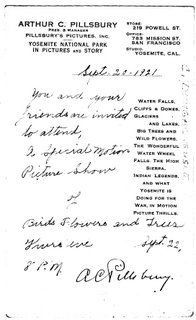
As you can see, the card is from 1910, the same year that AC took the first ship to ship photos at the San Dominguez Air Show in Los Angeles. The card is a cheerful advertisement for the motion pictures of nature that AC was using to increase his market share as a concessionaire in Yosemite. Competition for the few thousand tourists who came through the Valley was fierce in those early days and AC was always the first to see how innovations could help him improve his position.

The card is laid out with text saying, “Dear________________

Am just eating dinner now after a delightful trip. This evening we visit the Pillsbury Studio, who also have the Three Arrows Studio in Yosemite, and later will enjoy an open air Stereopticon Show.

The Motion Picture Show by Pillsbury in Yosemite is a wonderful treat. Will write more tomorrow.” (and the sender, relieved of the need to think of anything else to say, then signed it.)

In the Spring issue I will quote from some of the letters written to the Park Service complaining about the innovations AC employed from other concessionaires demanding he be stopped!

The card was a give away, provided to the visitors at the Del Portal who were on their way into the Valley. They could read it and get the message and then send it on to a friend or family member, letting them know they had arrived safely. The front of the card is a standard production post card of the Del Portal, probably familiar to all of you.

Marilynn actually sent two scans from advertising cards and the second one also told a story that, if I had known it at the time, I might have included in the Inside Story Post Card for the First Aeroplane into Yosemite.

The other side of this card is the interesting image of a girl dressed like an American Indian holding an American Flag and standing out on Overhanging Rock. I have seen the post card without this advertising and note on many occasions and it looks like my Aunt Grace. The card was originally made in a flood of patriotic fervor at the beginning of WWI while AC was attempting with his usual energy to join the corp of much younger men who were floating in balloons over enemy lines in France taking photos of enemy placements. The life expectancy was very short, sort of like being a forward observer in Vietnam.

The war was over too soon for AC to finish using up all of the cards that he printed so in the usual thrifty New England fashion he continued to use them until they were gone. This one, with hand written invitation to a motion picture showing of, “Birds, flowers and trees.” on September 22, 1921.

AC's attempts to become dead in France are chronicled on the Inside Story Post Card.

That is all for the Winter. See you next year and have a wonderful and completely Pillsbury Christmas.